Has Tipping Culture Gone Too Far?
How to thoughtfully navigate the new rules of tipping without guilt, resentment or second-guessing yourself.

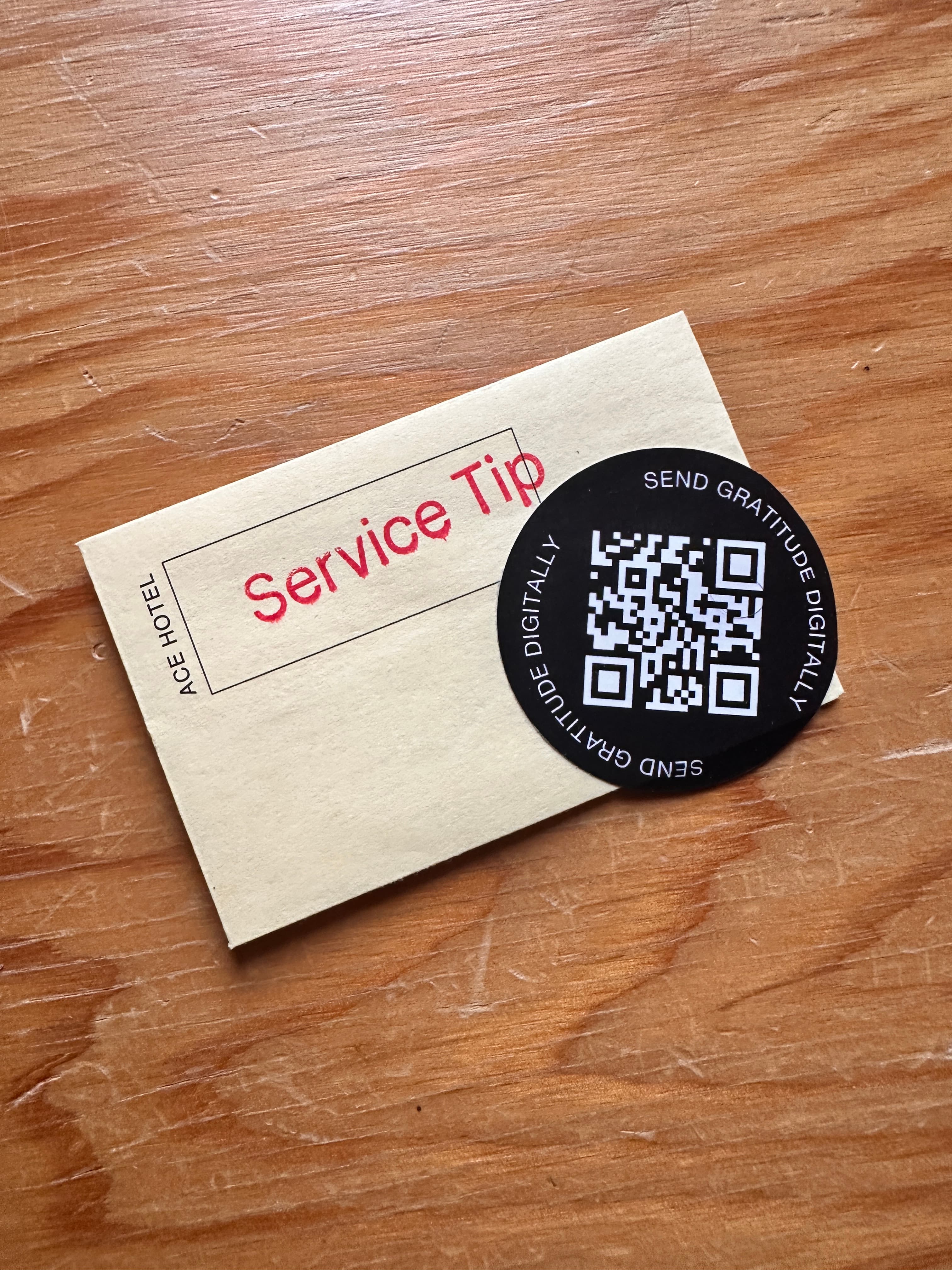
Laurie Jennings at the Ace Hotel in Toronto
If you're anything like me, you've gotten used to seeing the tip jar (complete with cheeky, hand-written reminder) at your favorite coffee shop or local bagel place. You probably do a little mental math and add something—maybe a dollar, maybe 10%—whether you’re paying with cash or card. Rarely do you leave nothing. You also consider yourself a good tipper at dine-in restaurants and tip on takeout, too.
So I’m curious: are you, too, noticing subtle (and not-so-subtle) reminders to tip… well, more? In more places? With more urgency?
The first time it registered for me was a few years ago on a family ski trip to Keystone, Colorado. Our hotel had a free shuttle to the mountain, and in almost every bus I noticed the driver had taped a piece of paper to the sun visor or the back of their seat—sometimes with a scribbled Venmo username, sometimes with a printed QR code, usually with a friendly smiley face. The message was clear: I’d love a tip. And I’m making it easy for you. Of course, you can read it two ways. One: it’s helpful, because almost nobody carries cash anymore. Two: it’s a cash grab, plain and simple.
I'm hearing more about this tipping culture trend, often called "tipping creep" or "tipflation" elsewhere, too. Last year, a friend mentioned they were surprised to see a tip jar for the pickleball instructor at an all-inclusive resort that proudly describes itself as tip-free (as most all-inclusive resorts do). She joked that she expected to tip at the spa, but was surprised to see it at the sports center. It made me wonder: Should we or shouldn't we? And why are we comfortable tipping the person who gives us a facial, but not the pickleball instructor?
The same goes for a recent hotel staycation vacation at a perfectly nice hotel—not luxury, not budget. When we got to our room, I found a quiet nudge to tip waiting for me: a labeled envelope for housekeeping tucked among the stationery on the desk. This felt like it crossed a line.
Now, I’ve always tipped housekeeping staff. (For the record, I also tip drivers, servers, stylists, spa therapists—anyone providing a personal service where tipping has long been part of the social contract.) What’s changed isn’t my generosity. It’s the feeling that tipping has shifted from something you choose to do to something you’re constantly being prompted to do.
I'm not the only person who feels this way: A 2023 study by Pew Research Institute reveals that 72% of Americans think there's more pressure to tip than there was five years ago and that the expectation to tip has spread to more places.
It makes me wonder: if the rules and social norms around tipping are changing, what guidelines should we follow now?
What is tipping culture?
Simply put: tipping culture is defined as "the social custom and expectation of providing extra money to service industry workers beyond their base wages." Historically, tipping has allowed business owners to pay lower wages with an unwritten understanding that tips act as a supplement for lower wages.
When Tipping Went From Courtesy to Constant
In the U.S., tipping has always been a strange hybrid of gratitude, economics, and social pressure. But in recent years—especially post-pandemic—it’s expanded rapidly and unevenly. Vermont-based etiquette expert Lizzie Post, co-host of the Awesome Etiquette podcast and co-president of the Emily Post Institute, put it plainly when I spoke with her: “I do think that tipping culture exploded, especially during the pandemic,” she says.
Post’s explanation is both compassionate and blunt. Early in the pandemic, she said, many of us were genuinely afraid we’d lose the places we loved: our coffee shops, restaurants, neighborhood haunts. She described how that fear “tugged at our heartstrings,” and those who could afford it started tipping more. At the same time, many workers were facing inflation and “not fully livable wages,” while businesses faced higher costs to operate. Post’s view: Much of that pressure got passed on to the customer.
And then came the screens.
“Tip screens really did end up everywhere. They became ubiquitous,” says Post. Some businesses didn’t even know how to turn tipping off in their payment systems, while others kept it because, essentially, why not?
In other words, tipping didn’t only expand because we became more generous. It expanded because the infrastructure made it frictionless—and because it offered businesses a way to avoid making prices (or wages) more transparent.
Tipping now shows up at:
coffee counters
fast-casual restaurants
hotel shuttles
self-checkout kiosks
after ride-share trips
and on digital checkout screens everywhere (even the wine store!)
There’s a name for this: tipping creep—the slow, steady spread of tipping into places and situations where it wasn’t previously expected, often without any service change to justify it. And it's leaving many of us scratching our heads. "I'm just not sure what to do anymore, and I'm terrified people will judge me if I don't tip," says one mom. "But do I really need to tip every time I buy a coffee?"
There’s even a name for how it makes people feel: tipping fatigue—the mental and emotional exhaustion that comes from being repeatedly asked to tip, calculate percentages, and make micro-moral decisions all day long.
That’s where tipping fatigue kicks in. People don’t necessarily mind tipping. They mind being nudged, guilted, and defaulted into tipping—especially when it’s unclear whether they’re rewarding service or subsidizing payroll.
How Uber and Lyft Contributed to Rewiring Tipping Behavior
Another factor contributing to the spike in tipping culture can be traced back to ride-share apps and the rise of gig-economy industries. When Uber first launched, no tipping was part of the appeal. The price was upfront. The transaction was clear. You exited the car, and that was that.
But as awareness grew around how little drivers were earning, tipping returned. This time, it arrived digitally, after the ride, without cash, conversation, or social ritual. Now you can even preset a tip in your settings.
Peak Confusion at Coffee Shops and Fast-Casual Counters
Few places illustrate tipping fatigue better than coffee shops and fast-casual restaurants. You order at the counter. You bus your own table. Sometimes you pour your own water. And yet there it is—the screen, already angled toward you—with tip options.
For many consumers, this is where resentment creeps in—not because they don’t value workers, but because the transaction no longer matches the expectation.
Historically, tipping was tied to service: table service, personalization, time spent. In fast-casual settings, that line has blurred. The result is uncertainty:
Is this expected—or just encouraged?
Am I undercutting wages if I don’t tip?
Or am I being asked to subsidize payroll?
The screen won’t answer that. And the ambiguity is exhausting. Lizzie Post’s etiquette line is refreshingly steady: “Our advice really hasn’t changed," she says. "Tipping in coffee shops is completely discretionary.”
Why Tipping Feels Especially Intense Right Now
If you dine out regularly in any major city, you’ve likely noticed another shift: tip presets have crept upward. What used to be 15%, 18%, and 20% is now often 20%, 22%, and 25%. Fifteen percent has quietly vanished, as if it were no longer acceptable, even though it was standard not long ago. Those preset buttons aren’t neutral. They’re behavioral nudges. When the lowest visible option is 20%, anything less feels like a statement—even if service was fine, even if fees were added, even if the total is already high. Choosing “custom” suddenly feels like pushing back. That emotional friction is the hallmark of tipping fatigue. The decision isn’t about appreciation anymore—it’s about avoiding judgment, awkwardness, or regret.
In high-cost cities like New York and San Francisco, rising rents, labor shortages, and razor-thin restaurant margins have collided. Rather than raise menu prices dramatically, many businesses rely on higher tip expectations to close the gap. "Servers are tipped wage employees," says Post. If you have a bad experience, “You need to use your words, not your money, to speak for you. Go talk to the manager if there’s a problem. Don't punish the server who relies on tips as part of their wages.”
But when local economic pressures are presented as universal etiquette, travelers and diners feel whiplash. What’s “normal” in one city feels excessive in another—and the screen doesn’t explain the difference.
A Practical Guide to Tipping
Sit-down restaurants: 15–20% is the baseline; many people default to 20% today. (Post emphasized keeping a floor at 15%.)
Bars: tip is customary (often per drink or as a % of the tab).
Salons/spas: tipping remains standard.
Hotel housekeeping: Post’s guideline: “It’s one to $2 per person per day.” If you receive daily service, tip daily—because you may not have the same housekeeper each day.
Baggage storage (hotel/front desk): $1–$2 per bag
Bell staff/bags to room: $1–$2 per bag
Concierge: if they secure hard-to-get tickets or special arrangements, she suggested $20–$25 can be appropriate, depending on the request and city
Hotel shuttle to airport: often $1–$2 per bag if they’re loading/unloading and helping; more discretionary if you’re managing everything yourself
Tours: varies by tour; often $5–$10 per person for a solid tour, more for day-long or high-effort experiences
If you're still struggling, ask yourself: Was this a personalized, hands-on service that made my life meaningfully easier or better? If yes, tipping often makes sense. If no, it’s reasonable to opt out.
How to Navigate Tipping Without Guilt
Here are some guidelines to help you make the best choice for you in most tipping scenarios:
1. Separate generosity from obligation.
Tip when you want to reward service, not because a screen cornered you.
2. Remember context.
At full-service restaurants, bars, salons, and spas, tipping is still part of the deal. For coffee counters, mechanics, lessons and retail checkouts, it's not. Use your discretion.
3. Use cash when it matters.
For housekeeping, cash remains the clearest way to ensure tips reach the right person. The same rule applies in a coffee shop.
5. Set your own baseline.
Decide in advance to remove stress in the moment.
6. Opting out isn’t unkind.
Declining to tip in a nontraditional context doesn’t make you cheap. It means you’re making a conscious choice, and that's okay.
7. Stop paying attention to what other people do.
Lizzie Post advises against watching what the person in front of you in line does. You shouldn't watch the tip screen of the person in front of you.” Her point was bigger than tipping—it was checkout privacy in general. Payment is a financial moment. Give people space. Don’t hover. Don’t watch.
8. Watch for double-dipping.
If there’s a service fee, ask where it goes before you assume you need to tip on top. If you're part of a large group, make sure the tip hasn't already been added.
Bottom Line
Clarity, fair wages, and honest pricing would go a long way toward easing the tension we’re all feeling. Until then, the most reasonable approach is a confident one: tip thoughtfully, tip consistently where it counts, opt out where it doesn’t—and try not to let a screen make you feel like a bad person either way. Keep tipping where it feels right. When you reward good service, you can't go wrong.
Post’s closing advice is also clear: “Have confidence in your tipping. Own it, feel good about it. You do not have to drain your wallet every time, but you should be thinking about leaving that little bit extra under the circumstances we talked about.” She continues: "Remember that the word gratitude and the word gratuity are very closely tied. Your tip is a thank you.”
Laurie Jennings is an award-winning writer and trusted editorial expert with expertise across health, travel, home, parenting, automotive and other consumer lifestyle categories, including product reviews and shopping advice. She turns rigorous product testing results into clear, actionable insights to help readers make smarter decisions.