The Hidden Cost of What We Wear
We break down what contributes to clothing’s environmental footprint.

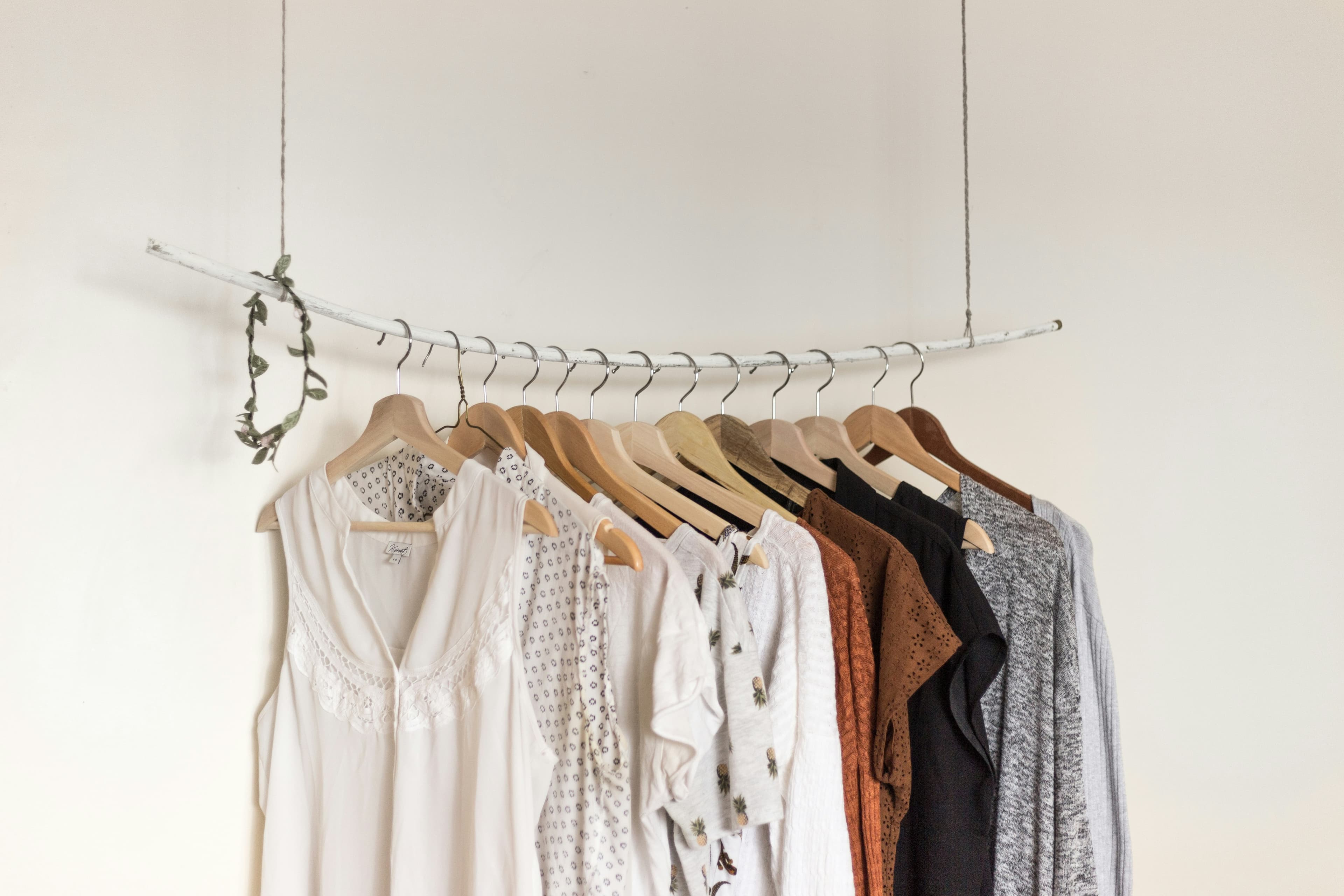
Photo: Priscilla Du Preez for Unsplash
We tend to judge clothing at the point of purchase.
Does it fit? Does it flatter? Is it worth the price?
For some shoppers, a product’s broader impact factors into the equation. For others, that can feel abstract and harder to evaluate than fabric weight or stitching quality. Either way, most decisions are shaped by what’s visible in front of us.
But a garment’s environmental impact neither begins at checkout nor ends when we’re finished wearing it.
By the time a shirt reaches a store, it has already lived a life. Fibers have been produced, fabrics dyed and treated, energy and water spent along the way. Once it comes home, daily habits take over — washing, drying, frequency of wear. Even its final destination — reuse, recycling, or landfill — becomes part of the equation.
To understand the real cost of what we wear, we have to zoom out and consider the full journey, not just the label or the price tag, but the broader lifecycle behind it, even if much of it remains out of view.
There is no perfect fabric and no single decision that solves everything. But when we widen the lens, the trade-offs become clearer and so do the opportunities to make more thoughtful choices.
Here’s how that footprint typically takes shape.
At the Source
Every garment begins with a raw material. And that starting point matters — though not always in the ways we assume.
Natural fibers like cotton and wool are often perceived as inherently better choices. Cotton is renewable and breathable. Wool is biodegradable and durable. But conventional cotton cultivation can require significant water and pesticide inputs, depending on where and how it’s grown. Wool production carries its own considerations, including land use and methane emissions.
Synthetic fibers such as polyester and nylon are derived from fossil fuels. They are energy-intensive to produce and do not biodegrade. Yet they are durable, lightweight, and often require less frequent replacement. Their longevity can reduce per-wear impact — while their tendency to shed microfibers during washing introduces another environmental trade-off.
Then there are semi-synthetic materials like viscose or rayon, made from plant-based cellulose but processed through chemical-intensive manufacturing systems. Depending on sourcing and oversight, their footprint can vary widely.
The reality is less about labeling fibers as “good” or “bad” and more about understanding trade-offs. Water use, land use, energy demand, chemical inputs, durability, and end-of-life potential all factor into the equation.
Material choice sets the foundation — but it doesn’t determine the entire story. Manufacturing practices, garment construction, consumer care, and longevity can amplify or mitigate the impact that begins at the fiber level.
No fiber is impact-free. And no single attribute tells the whole story.
In the Making
Turning raw material into a finished garment involves multiple stages — spinning, weaving or knitting, dyeing, finishing, cutting, and sewing. Each step requires energy. Many require water. Some rely on chemical treatments designed to alter color, texture, wrinkle resistance, or performance.
Dyeing and finishing are often among the most resource-intensive stages. Achieving a deep, uniform color can require repeated washes and chemical baths. Treatments that make fabric stain-resistant, moisture-wicking, or wrinkle-free add additional processing layers.
Even a garment that looks simple — like a crisp white shirt — may have undergone bleaching, optical brightening, and finishing processes to achieve its final appearance.
Denim tells a similar story. A pair of jeans may begin as sturdy cotton, but the signature indigo color, fading, whiskering, or distressed effects often involve additional dye baths, stone washing, enzyme treatments, or sanding.
The more “lived-in” the finish, the more processing it may have required to get there.
These impacts accumulate long before a consumer makes a purchase decision.
By the time a piece reaches a store rack, much of its environmental load has already been shaped, even though its lifetime impact will continue to evolve with how it’s worn and cared for.
On the Move
Once a garment is made, it rarely stays in one place. Fabrics may be milled in one country, cut and sewn in another, finished somewhere else, and ultimately shipped to distribution centers and retail stores around the world.
It’s easy to assume that this journey — often measured in thousands of miles — is the dominant driver of environmental impact. Distance feels tangible. Shipping labels make it visible.
Transportation does contribute to a garment’s footprint, particularly when air freight is involved. But in many lifecycle analyses, it represents a smaller share of total impact than fiber production, dyeing, finishing, or long-term use. Ocean freight, which carries most global apparel, is comparatively efficient per unit transported.
This doesn’t mean distance is irrelevant. It means miles traveled don’t tell the whole story.
Understanding where impact concentrates helps shift the conversation from miles traveled to the processes and habits that shape a garment’s footprint over time.
At Home
Once a garment enters your closet, its footprint continues to evolve.
How often it’s worn and how frequently it’s washed. Whether it’s dried on high heat or hung to air dry. These everyday routines shape a garment’s long-term impact more than we might expect. Studies of clothing use practices suggest that wash frequency is often guided by social norms and perceptions of cleanliness rather than garment necessity.
Laundering requires energy and water. Heated wash cycles and machine drying increase energy demand, and life cycle assessments of garments consistently show that higher-temperature programs raise overall impact compared to colder cycles. Washing in cold water, particularly in regions where water heating relies on fossil fuels, reduces energy consumption, and line drying when practical can significantly reduce that energy demand.
Repeated laundering, particularly at higher temperatures and longer wash times, has been shown to accelerate color fading, dye transfer, and microfibre release, all of which can also contribute to earlier garment replacement.
Not every item needs to be washed after a single wear. Denim, outerwear, and many knit garments can often be aired out between uses. Activewear and heavily soiled pieces may require more frequent laundering, but being intentional about when to wash offers one of the simplest ways to influence a garment’s footprint.
Just as important is how often a garment is worn. A garment worn 100 times carries a very different per-wear footprint than one worn five times. Extending use delays replacement and the environmental costs of making something new.
After Wear
Eventually, every garment reaches the end of its useful life.
What happens next varies widely. Some items are resold, repaired, or repurposed. Others are donated, downcycled into insulation or industrial materials, or sent to landfill. A smaller fraction is recycled back into textile fibers.
Textile recycling remains technically and logistically complex. Many garments are made from blended materials — cotton mixed with polyester, elastane, or other fibers — which makes fiber separation difficult at scale. Even when collection systems exist, infrastructure for true fiber-to-fiber recycling is still developing.
In landfills, natural fibers may degrade over time, while synthetic materials can persist much longer. No pathway is impact-free.
End-of-life decisions matter, but by this stage much of a garment’s footprint has already been shaped. Extending use, repairing when possible, and purchasing with durability in mind often have a greater influence than disposal alone.
Understanding this final chapter doesn’t mean every item must be saved indefinitely. It reinforces a broader truth: impact accumulates across a garment’s life, not just at the moment it leaves our closet.
The Human Side of the Story
Environmental impact tells only part of the story. Behind every garment are people — from fiber growers to factory workers — whose labor shapes how and under what conditions it is made.
Working standards, wages, and supply chain transparency vary widely, and they are not always visible on a label. For readers interested in the labor dimension of the textile and apparel sector, the International Labour Organization provides ongoing research and global reporting on working conditions and employment trends.
While this article focuses on environmental footprint, a fuller understanding of what we wear includes the human systems behind it — a dimension that warrants careful attention.
The Takeaway
The impact of what we wear is cumulative. It builds across raw materials, manufacturing, transportation, maintenance, and eventual disposal. No single lever solves everything, but each one contributes.
Understanding that accumulation reframes value. Durability, care, and frequency of wear matter as much as style, brand name, or price. Thoughtful choices may not eliminate impact, but they can meaningfully shape it.
Birnur Aral, PhD, is a chemical engineer and consumer product expert with a career spanning research and development, testing, and sustainability. She brings a rigorous, evidence-first lens to product claims and consumer-facing topics.